

A rare and unforgettable sighting in Hluhluwe-iMfolozi There are moments in the bush that linger long after the dust settles and the engine switches off. Moments when the wilderness feels alive in a different way — charged, electric and full of quiet tension. They are not always dramatic or loud. Often, they unfold in silence, in a slow unfolding of awareness that something extraordinary is about to happen.
The Curious Charm of St Lucia's Warthogs
Posted on Tue July 7, 2026.
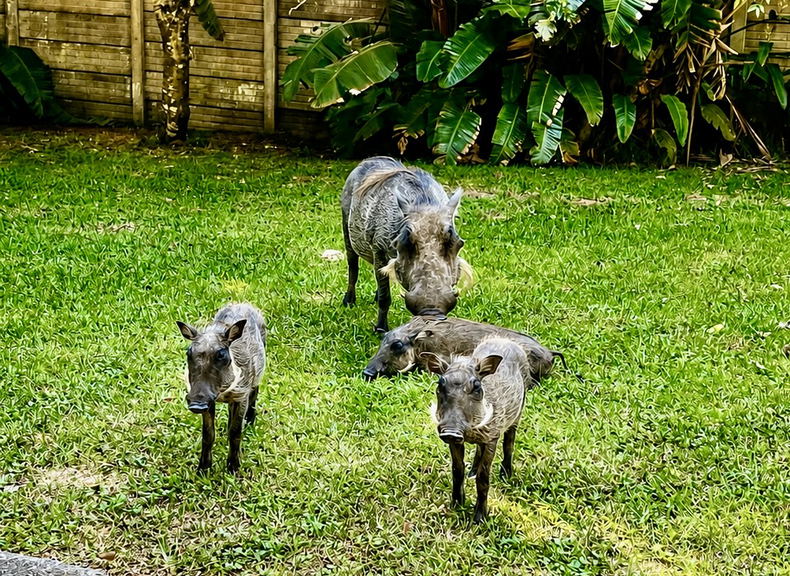
Why one of Africa's so-called "Ugly Five" may just become your favourite wildlife encounter
Long before the sun has climbed above the tree canopies and lush tropical vegetation, St Lucia is already stirring.
A trumpeting hornbill announces the new day. Palm fronds sway gently in the coastal breeze. Somewhere in the distance, a fish eagle delivers its unmistakable call across the estuary.
Then, without ceremony, a warthog appears.
It emerges from between the indigenous gardens as though it owns the place, which, in many respects, it does. It pauses briefly, surveys the morning with quiet confidence, before continuing on its unhurried journey through town. A vehicle slows to let it pass. A couple enjoying their morning coffee stops mid-conversation. Cameras appear almost instinctively.
Nobody seems particularly surprised.
This is simply another morning in St Lucia.
For first-time visitors, the experience borders on surreal.
Few places in Africa offer such an intimate coexistence between people and wildlife. While the town is internationally known for its nocturnal hippo patrols, there is another resident that quietly wins over almost everyone who visits.
The warthog.
Often overlooked on safari and affectionately labelled one of Africa's "Ugly Five"—a tongue-in-cheek list celebrating the continent's less conventionally handsome animals—the warthog suffers from one of the greatest public relations injustices in the animal kingdom.
Spend even a day in St Lucia, however, and that reputation begins to unravel.
Because ugly?
Not quite.
Endearing?
Without question.
The town's warthogs seem to have mastered the delicate balance between remaining completely wild while becoming remarkably accustomed to life around people.
They wander through residential gardens in search of fresh grass. They amble along pavements with the confidence of lifelong locals. Occasionally, they decide that the centre of the road is the ideal place to stop for lunch, reducing traffic to a patient crawl while motorists quietly wait their turn.
There are no raised voices.
No impatient horns.
Only smiles.
It's an unspoken agreement that, here, wildlife has right of way.
The youngest members of these little families are impossible not to admire. Covered in soft bristles and carried on impossibly long legs that always seem one size too large, young warthogs possess an irresistible curiosity. They investigate everything, the world still wonderfully new to them, before darting back towards the reassuring presence of their mother.
And then there are the tails.
Perhaps no other African mammal has such an instantly recognisable silhouette.
Whenever a family begins to move with purpose, every tail rises perfectly upright, resembling tiny radio aerials or miniature flagpoles bobbing through the grass. The behaviour is more than comic, it serves as a practical way for piglets to keep visual contact with one another when moving through tall vegetation.
Nature, as always, combines function with unmistakable character.
The more time one spends watching warthogs, the more fascinating they become.
Take meals, for example.
Unlike antelope or zebra that simply lower their heads to graze, warthogs perform one of nature's most distinctive rituals. They carefully fold their front legs beneath them, lowering themselves onto specially developed calloused pads on their knees before grazing.
The pose appears almost ceremonial, as though they are saying grace before every meal.
Those hardened knee pads are an extraordinary adaptation, allowing them to spend long periods feeding close to the ground without discomfort.
It is one of countless reminders that evolution rarely concerns itself with elegance—only efficiency.
Of course, no discussion of warthogs would be complete without mentioning the feature that gave them their rather unfortunate name. The "warts" themselves are not warts at all, they are thick protective pads that cushion the face during clashes between rival males.
Their magnificent ivory tusks are equally impressive, the upper pair curve gracefully skywards, sometimes exceeding 25 centimetres in length, while the lower tusks remain razor sharp through constant sharpening against their upper counterparts. Though formidable in appearance, these tusks are used primarily for defence against predators such as lions and leopards rather than for aggression.
Faced with danger, a warthog's first instinct is usually flight.
And despite appearances, they are astonishingly quick, capable of reaching speeds approaching 50 kilometres per hour, they can transform from leisurely lawnmower to sprinting athlete in an instant.
Home, interestingly enough, is usually borrowed. Rather than excavating their own shelters, warthogs are opportunists, taking over abandoned aardvark burrows that provide welcome relief from the midday heat and safe refuge for mothers raising young piglets.
They even reverse into these burrows, ensuring that if an unwelcome visitor arrives, a formidable pair of tusks is already facing the entrance.
It's a wonderfully simple survival strategy.
Although they often appear delightfully comical, warthogs play an important ecological role throughout Africa's savannas. As dedicated grazers, they help maintain grasslands by feeding on fresh growth, while their digging and rooting aerate the soil, recycle nutrients and create opportunities for new plants to establish.
Even abandoned burrows continue serving the ecosystem, providing shelter for countless other species long after the original occupants have moved on.
Like so many animals, their value extends far beyond their appearance
Perhaps that is what makes St Lucia's warthogs so captivating.
Here, they are not distant subjects viewed through binoculars from a safari vehicle.
They are simply part of everyday life.
One might appear while you're enjoying breakfast on a veranda. Another may quietly stroll past while you're walking to dinner. A family may emerge unexpectedly from beneath a cluster of palms before disappearing just as effortlessly into the surrounding bush.
These encounters never feel staged.
They feel authentic.
A quiet reminder that St Lucia remains one of the few places where nature has not retreated behind fences, but continues to move freely through the rhythm of daily life.
The famous Big Five will always command attention.
The elephant inspires awe.
The leopard remains elusive.
The lion captures imaginations.
Yet it is often the smaller, quieter encounters that linger longest in memory.
A family of warthogs crossing the road at sunrise.
Piglets trotting determinedly behind their mother, tails held high like tiny banners.
The gentle rustle of grass as they disappear into the coastal forest.
Perhaps the "Ugly Five" title has always missed the point.
Because beauty in the wild is rarely about perfection.
Sometimes, it is about personality.
And by that measure, few animals possess more charm than the humble warthog.
Share This Post
Our Tripadvisor Reviews
Further Reading
Painted Wolves of Zululand: When the Wild Dogs Return
Fri February 27, 2026
Read This Article
The World Beneath the Obvious, The Remarkable Small Lives in and Around St Lucia
Wed January 14, 2026
Read This Article
St Lucia is often described by what surrounds it, a small coastal town enveloped by the remarkable iSimangaliso Wetland Park, where estuary, forest, dune systems, and ocean converge. Here, nature is not confined to distant viewpoints or fenced reserves. It threads itself through daily life, moving quietly between gardens, along sandy paths, beneath leaves, and across walls. While larger animals understandably capture the imagination, another world exists alongside them — smaller, subtler,...
How Many Nights Do You Really Need in St Lucia, South Africa?
Thu December 25, 2025
Read This Article
St Lucia is not a destination built around ticking off attractions. It’s a place shaped by tides and wildlife, early mornings and quiet evenings — where the most memorable moments tend to unfold slowly rather than on demand. That’s why one of the most common questions we receive from guests planning a visit is also one of the most important: “How many nights should we stay?” The answer has less to do...
Share This Post