

A rare and unforgettable sighting in Hluhluwe-iMfolozi There are moments in the bush that linger long after the dust settles and the engine switches off. Moments when the wilderness feels alive in a different way — charged, electric and full of quiet tension. They are not always dramatic or loud. Often, they unfold in silence, in a slow unfolding of awareness that something extraordinary is about to happen.
The World Beneath the Obvious, The Remarkable Small Lives in and Around St Lucia
Posted on Wed January 14, 2026.
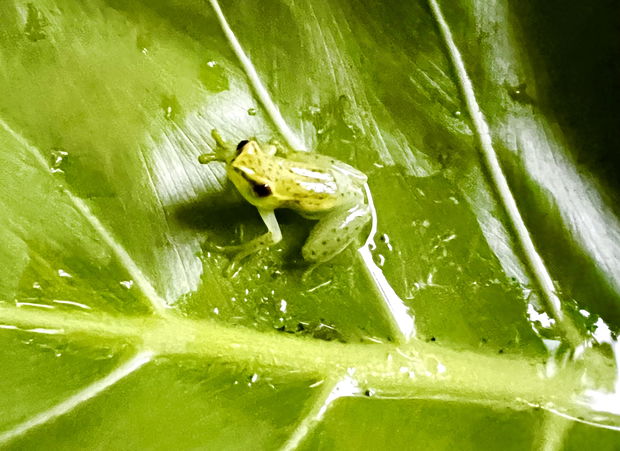
St Lucia is often described by what surrounds it, a small coastal town enveloped by the remarkable iSimangaliso Wetland Park, where estuary, forest, dune systems, and ocean converge. Here, nature is not confined to distant viewpoints or fenced reserves. It threads itself through daily life, moving quietly between gardens, along sandy paths, beneath leaves, and across walls. While larger animals understandably capture the imagination, another world exists alongside them — smaller, subtler, and no less extraordinary.
That world often reveals itself in moments of stillness. A small green tree frog perched motionless on a broad philodendron leaf, its colour so perfectly matched that it appears almost grown from the plant itself. The frog is not hiding, it simply belongs so precisely to its surroundings that it disappears into them. In St Lucia, scenes like this are surprisingly common — but only for those who pause long enough to notice.
Frogs are among the most quietly abundant residents of the area. Rather than a single familiar species, St Lucia hosts a variety of tree frogs and reed frogs, each adapted to specific niches. Some cling to grasses near wetlands, others shelter in shrubs and garden plants, while larger species announce summer rains with powerful night-time calls. Many depend on seasonal water and clean environments, making their presence a living indicator of ecological health. When frogs thrive, it is usually because everything else around them is working as it should.
After hippos move through the estuary and surrounding wetlands, another group of specialists arrives with remarkable speed. Dung beetles emerge to begin their work, shaping and rolling dung into improbably large balls. The sight is often amusing, but the impact is profound. By burying dung, these beetles recycle nutrients into the soil, improve water absorption, reduce parasites, and assist with seed dispersal. In landscapes as biologically productive as those around St Lucia, dung beetles quietly maintain balance from the ground up.
Among the shrubs and forest margins lives one of the region’s true hidden treasures — the St Lucia dwarf chameleon. This small, elusive reptile is endemic to the area, occurring naturally nowhere else on Earth. Unlike its larger, more flamboyant relatives, it relies on restraint rather than display. Subtle colour shifts, slow deliberate movement, and remarkable stillness are its primary defences. Independently rotating eyes allow it to survey its surroundings with precision, while its prehensile tail anchors it securely to narrow branches. Encountering one often feels less like a sighting and more like being granted access to a secret.
After rainfall, the ground itself seems to stir. Giant African land snails emerge from hiding, their shells bearing the marks of years of slow growth. Though frequently overlooked, these snails are essential decomposers, breaking down plant material and returning nutrients to the soil. Their unhurried pace offers a quiet counterpoint to the rapid movement of insects and birds above them.
As the day warms, butterflies drift through gardens, forest clearings, and dune vegetation, many of them closely tied to specific host plants. Their presence reflects the botanical diversity of the region. Dragonflies patrol wetlands and ponds with purpose, their sudden turns and hovering flight betraying remarkable aerial skill. Long before they take to the air, dragonflies live as aquatic larvae for months or even years, making them sensitive indicators of water quality. Where dragonflies flourish, wetlands are usually healthy.
As evening approaches, geckos appear on walls and ceilings, their soft clicking calls becoming part of the night-time soundscape. Skinks flash briefly through leaf litter, quick and reflective. Praying mantises wait motionless among stems, masters of patience and disguise. Each of these creatures occupies a precise role, contributing to a system that depends as much on the small and subtle as it does on the large and dramatic.
What unites these lesser-noticed residents is their quiet indispensability. They connect soil to plant life, water to land, decay to renewal. Without them, the larger animals and sweeping landscapes that define this region could not exist in balance.
For visitors, discovering this smaller world often happens unexpectedly — during a morning walk, beside a puddle after rain, or while lingering in a garden corner. Places like Lidiko Lodge simply offer one vantage point among many, where the boundary between cultivated space and wilderness blurs, and these creatures continue their lives largely undisturbed.
To truly experience St Lucia is not only to look outward toward iconic wildlife and vast scenery, but inward — toward leaves, soil, and stillness. The wild here does not always announce itself loudly. Sometimes, it waits patiently, perfectly camouflaged, until someone learns how to look a little closer.
Share This Post
Our Tripadvisor Reviews
Further Reading
Painted Wolves of Zululand: When the Wild Dogs Return
Fri February 27, 2026
Read This Article
How Many Nights Do You Really Need in St Lucia, South Africa?
Thu December 25, 2025
Read This Article
St Lucia is not a destination built around ticking off attractions. It’s a place shaped by tides and wildlife, early mornings and quiet evenings — where the most memorable moments tend to unfold slowly rather than on demand. That’s why one of the most common questions we receive from guests planning a visit is also one of the most important: “How many nights should we stay?” The answer has less to do...
The Hidden Seasons of St Lucia
Thu December 4, 2025
Read This Article
A More Colourful Look at Nature’s Secret Calendar... Most travellers arrive in St Lucia expecting sunshine, sandy beaches, and safari adventures. But those who linger a little longer, who pause to watch the tide shift or listen to the night sounds from the forest, quickly realise something: this place moves to a rhythm far older and far richer than the four seasons printed on a calendar. St Lucia lives by nature’s seasons...
Share This Post